Why Content Marketing Works for Small Business Owners in 2025
Content marketing has become the backbone for small business owners looking to stay competitive in 2025. Everyone talks about flashy ads and paid campaigns, but the numbers tell a different story. Businesses that provide educational and transparent content see a 67 percent higher customer retention rate than those using traditional advertising. So while it might look like the biggest winners are spending big on ads, the smartest small businesses are winning trust and customers with simple, authentic content.
Content marketing builds trust through authenticity
Delivering valuable and genuine content creates strong connections with potential customers.
Align content with the customer journey
Different types of content should match each phase of the customer journey to drive sales effectively.
Leverage storytelling to create emotional connections
Real experiences and customer success stories enhance trust and resonate better with audiences.
Utilize data analytics for content strategy
Advanced analytics can enhance content performance by understanding audience engagement and needs.
Focus on cost-effective, quality content
High-quality content provides long-term value without heavy financial investment, ideal for small businesses.
How Content Marketing Builds Trust
Trust is the cornerstone of any successful business relationship. For small business owners, content marketing emerges as a powerful tool to establish genuine connections with potential customers. By consistently delivering valuable, authentic information, businesses can transform casual audiences into loyal supporters.
The Psychology of Trust Through Content
Content marketing works by tapping into fundamental human psychological needs. People naturally gravitate toward businesses that demonstrate expertise, transparency, and genuine understanding of their challenges. Our guide on digital marketing strategies reveals that consumers are increasingly sophisticated in their decision making. According to research from the Content Marketing Institute, businesses that provide educational and transparent content see a 67% higher customer retention rate compared to traditional advertising methods. This statistic underscores a critical insight: modern consumers want more than sales pitches. They seek meaningful interactions that help them solve problems and make informed decisions.
Authentic Storytelling as a Trust Mechanism
Storytelling represents a powerful trust-building strategy within content marketing. Research published in 2023 exploring storytelling’s impact on social media consumers demonstrates that authentic narratives create emotional connections far more effectively than purely transactional communication. Small business owners can leverage storytelling by:
Sharing Real Experiences: Discuss genuine challenges and how your business solved them.
Highlighting Customer Journeys: Showcase real customer transformations and success stories.
Demonstrating Vulnerability: Show the human side of your business through honest communication.
By consistently delivering content that prioritizes value over sales, small businesses can establish themselves as trusted resources in their industry. This approach transforms content from a marketing tactic into a genuine relationship-building tool that resonates with modern consumers seeking authenticity and expertise. The key is to focus on solving problems, providing insights, and creating content that genuinely helps your target audience navigate their challenges. When businesses shift from selling to serving, trust naturally follows.
Driving Leads and Sales with Content
Content marketing has evolved from a supplementary strategy to a critical driver of business growth for small business owners. By creating strategic, targeted content, businesses can effectively transform audience engagement into tangible sales opportunities.
Strategic Content Alignment with Customer Journey
Research from Northwestern University’s Kellogg School of Management demonstrates that digital content marketing tools like webinars and white papers are more effective in generating sales leads than traditional in-person events. This reveals a fundamental shift in how businesses connect with potential customers. Successful content marketing requires precise alignment with different stages of the customer journey. Learn more about crafting compelling headlines that capture attention and drive potential customers through the sales funnel. Each piece of content should serve a specific purpose:
Awareness Stage: Educational blog posts and infographics that introduce solutions
Consideration Stage: Detailed guides and comparison content that showcase expertise
Decision Stage: Case studies and testimonials that provide social proof
To help visualize how content aligns to the customer journey, here’s a table summarizing the recommended content types for each stage: Content alignment with the customer journey is essential for effective marketing. The following table summarizes which types of content work best at each stage.
By systematically analyzing these metrics, businesses can refine their content strategy and improve lead generation capabilities. The goal is not just creating content but creating content that directly contributes to business growth. Small businesses have a unique advantage in content marketing. Their ability to create personalized, authentic content allows them to connect more intimately with their target audience compared to larger, more impersonal corporations. This connection translates directly into increased trust and, ultimately, more sales.
Cost-Effective Growth for Service Businesses
Service businesses often operate with limited marketing budgets, making cost-effective growth strategies critical for survival and success. Content marketing emerges as a powerful solution that allows small businesses to compete effectively without massive financial investments.
Maximizing Marketing Budget Efficiency
Research from Capterra highlights that content marketing provides a measurable and optimizable approach to business growth. Unlike traditional advertising methods that require substantial upfront costs, content marketing enables businesses to create valuable assets that continue generating returns long after initial creation. Key cost advantages include:
Low production expenses compared to traditional advertising
Longer content lifecycle and sustained audience engagement
Ability to repurpose content across multiple platforms
Direct correlation between content quality and audience attraction
To clearly compare the cost advantages of content marketing versus traditional advertising, the following table outlines the key differences based on information from the article: This table highlights how content marketing provides greater value and efficiency than traditional advertising for small businesses.
Factor
Content Marketing
Traditional Advertising
Upfront Expenses
Low to Moderate
High
Content Lifecycle
Long (evergreen, reusable)
Short (campaign based)
Repurposing Potential
High (multi-platform)
Low
Returns Over Time
Cumulative, ongoing
Limited to campaign duration
Discover strategies for efficient online marketing that can help service businesses maximize their digital presence without breaking the bank. The goal is strategic content creation that attracts and converts potential customers.
Scalable Content Strategies for Small Budgets
According to research from Go Be Rewarded, content marketing represents a long-term strategy that helps businesses build brand recognition and drive website traffic with minimal financial investment. Service businesses can implement cost-effective content strategies such as:
Creating blog posts addressing customer pain points
Developing educational video content
Producing downloadable guides and resources
Leveraging user-generated content and testimonials
These approaches require more intellectual investment than financial resources. By focusing on providing genuine value, service businesses can attract potential clients without expensive marketing campaigns. The true power of content marketing lies in its ability to establish expertise, build trust, and create meaningful connections. Small service businesses can compete with larger competitors by producing high-quality, targeted content that speaks directly to their ideal customer’s needs and challenges. This approach transforms marketing from a cost center into a strategic growth engine, allowing businesses to expand their reach and influence without exhausting limited resources.
Proven Content Strategies for 2025
As digital marketing continues to evolve, small business owners must adapt their content strategies to remain competitive and relevant. The landscape of content marketing in 2025 demands innovative approaches that blend technological insight with genuine human connection.
Emerging Content Formats and Technologies
The future of content marketing hinges on personalization and interactive experiences. Explore advanced social media marketing techniques that can help businesses stay ahead of emerging trends. Businesses should focus on developing content strategies that leverage:
AI-Powered Personalization: Using machine learning to create hyper-targeted content experiences
Interactive Content: Quizzes, assessments, and dynamic video experiences that engage audiences
Short-Form Video Content: Platforms like TikTok and Instagram Reels continue to dominate audience attention
Data-Driven Content Development
Successful content strategies in 2025 will rely heavily on sophisticated data analytics. Research from Content Marketing Institute indicates that businesses using advanced analytics can improve content performance by up to 45%. This means:
Tracking granular audience engagement metrics
Using predictive analytics to anticipate content needs
Implementing real-time content optimization
Authenticity and Value-Driven Content
According to a comprehensive digital marketing study, consumers in 2025 will increasingly prioritize brands that demonstrate genuine value and social responsibility. Small businesses can differentiate themselves by:
Creating transparent, purpose-driven content
Addressing social and environmental challenges
Showcasing real customer experiences and transformations
The most effective content strategies will blend technological innovation with authentic storytelling. Small business owners must think beyond traditional marketing approaches and view content as a meaningful conversation with their audience. By combining data-driven insights, emerging technologies, and genuine human connection, businesses can create content that not only attracts attention but builds lasting relationships. The key is to remain adaptable, continuously learn, and prioritize delivering genuine value to your audience.
Frequently Asked Questions
What is content marketing, and why is it important for small businesses in 2025?
Content marketing refers to the creation and sharing of valuable content to attract and retain customers. In 2025, it is crucial for small businesses because it builds trust, enhances customer retention, and drives sales more effectively than traditional advertising methods.
How can small businesses build trust with content marketing?
Small businesses can build trust by delivering authentic and educational content that addresses their audience’s challenges. Storytelling, sharing real customer experiences, and being transparent about business practices are effective strategies for establishing trust.
What types of content should small businesses create at different stages of the customer journey?
At the awareness stage, small businesses should focus on educational blog posts and infographics. During the consideration stage, detailed guides and comparison content are useful. Finally, case studies and testimonials should be presented at the decision stage to provide social proof and encourage purchases.
How can small businesses measure the effectiveness of their content marketing efforts?
Small businesses can measure effectiveness by tracking key performance indicators such as conversion rates, engagement metrics, lead generation numbers, and customer acquisition costs. Analyzing these metrics helps refine the content strategy to improve lead generation and sales.
Ready to Transform Your Trust-Building Content Into Real ROI?
Are you struggling to get results from your website or online presence, even though you know content marketing is the best move for 2025? This article shows how authentic storytelling, smart alignment with your customer journey, and cost-effective growth can turn browsers into believers. But maybe you feel overwhelmed by the technical details or unsure how to get measurable performance from your efforts. Finepoint Design understands the stress of wanting growth but not knowing where to start. Our services are built to help small business owners just like you use digital marketing, website development, and improved search engine strategies to move from ideas to impact. Explore the possibilities of getting real ROI from your marketing and letting content do the heavy lifting for your business every day. Stop waiting for big budgets or luck to drive your results. Visit Finepoint Design right now and see how our approach can help you align, execute, and measure content marketing for actual business growth. Take your next step toward lasting trust and reliable sales with the team that turns strategy into outcomes.
 Content marketing has become the backbone for small business owners looking to stay competitive in 2025. Everyone talks about flashy ads and paid campaigns, but the numbers tell a different story. Businesses that provide educational and transparent content see a 67 percent higher customer retention rate than those using traditional advertising. So while it might look like the biggest winners are spending big on ads, the smartest small businesses are winning trust and customers with simple, authentic content.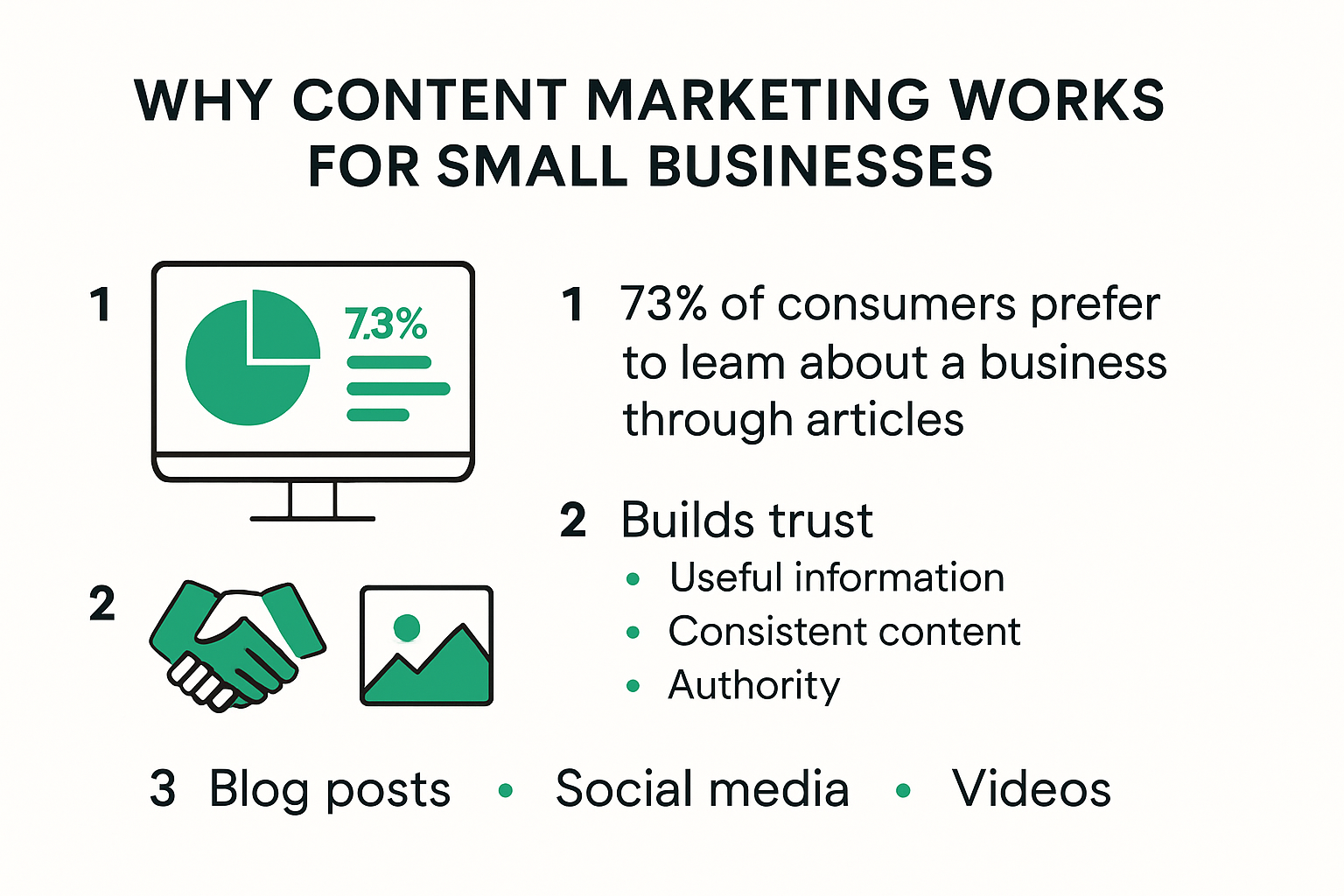

 Stop waiting for big budgets or luck to drive your results. Visit Finepoint Design right now and see how our approach can help you align, execute, and measure content marketing for actual business growth. Take your next step toward lasting trust and reliable sales with the team that turns strategy into outcomes.