7 Branding Mistakes to Avoid for Small Business Success
Building a brand that actually sticks in people’s minds is hard. Even small mistakes in communication can trip up your business and send customers looking elsewhere. Did you know that inconsistency in your brand’s messaging can drop potential trust and recognition by more than half but so many business owners miss this silent mistake. Most think a bold logo is enough but real brand power comes from something most companies overlook and that’s where successful brands break away from the crowd.
Table of Contents
- Step 1: Identify Inconsistent Brand Messaging
- Step 2: Define Your Target Audience Clearly
- Step 3: Analyze Competitor Branding Strategies
- Step 4: Develop A Cohesive Brand Identity
- Step 5: Test Branding Elements With Focus Groups
- Step 6: Monitor Brand Perception And Adjust
Quick Summary
| Key Point | Explanation |
|---|---|
| 1. Ensure Brand Messaging Consistency | Conduct an audit of all communication channels to identify and rectify any inconsistencies in tone, language, and visuals. |
| 2. Clearly Define Your Target Audience | Develop detailed customer personas that capture demographics, motivations, and communication preferences to enhance engagement. |
| 3. Analyze Competitor Branding Strategies | Examine competitors’ visual identity and messaging to identify gaps and opportunities for differentiation in your branding. |
| 4. Develop a Cohesive Brand Identity | Create a comprehensive brand style guide to ensure consistency across visual and messaging elements that represent your business. |
| 5. Monitor Brand Perception Regularly | Implement monitoring tools to track feedback and adapt your branding strategy based on customer perceptions and evolving market dynamics. |
Step 1: Identify Inconsistent Brand Messaging
Inconsistent brand messaging can silently sabotage your small business’s growth and credibility. When your communication lacks coherence across different platforms and interactions, potential customers become confused about who you are and what you stand for. Brand messaging consistency is the foundation of building trust and recognition.
To identify inconsistent messaging, start by conducting a comprehensive audit of all your current communication channels. Review your website, social media profiles, marketing materials, email communications, and customer interaction scripts. Look for variations in tone, language, visual style, and core messaging that might send mixed signals to your audience.
Carefully examine whether your brand voice sounds the same whether someone reads your website’s about page, scrolls through your social media, or receives a customer service email. Are you presenting yourself as professional and formal in one place and casually conversational in another? Subtle differences can create significant perception gaps.
Documenting your current messaging will help you pinpoint inconsistencies. Create a brand messaging guide that outlines your core values, unique selling propositions, target audience, and preferred communication style. This document becomes your north star for ensuring every piece of communication aligns with your brand’s authentic identity.
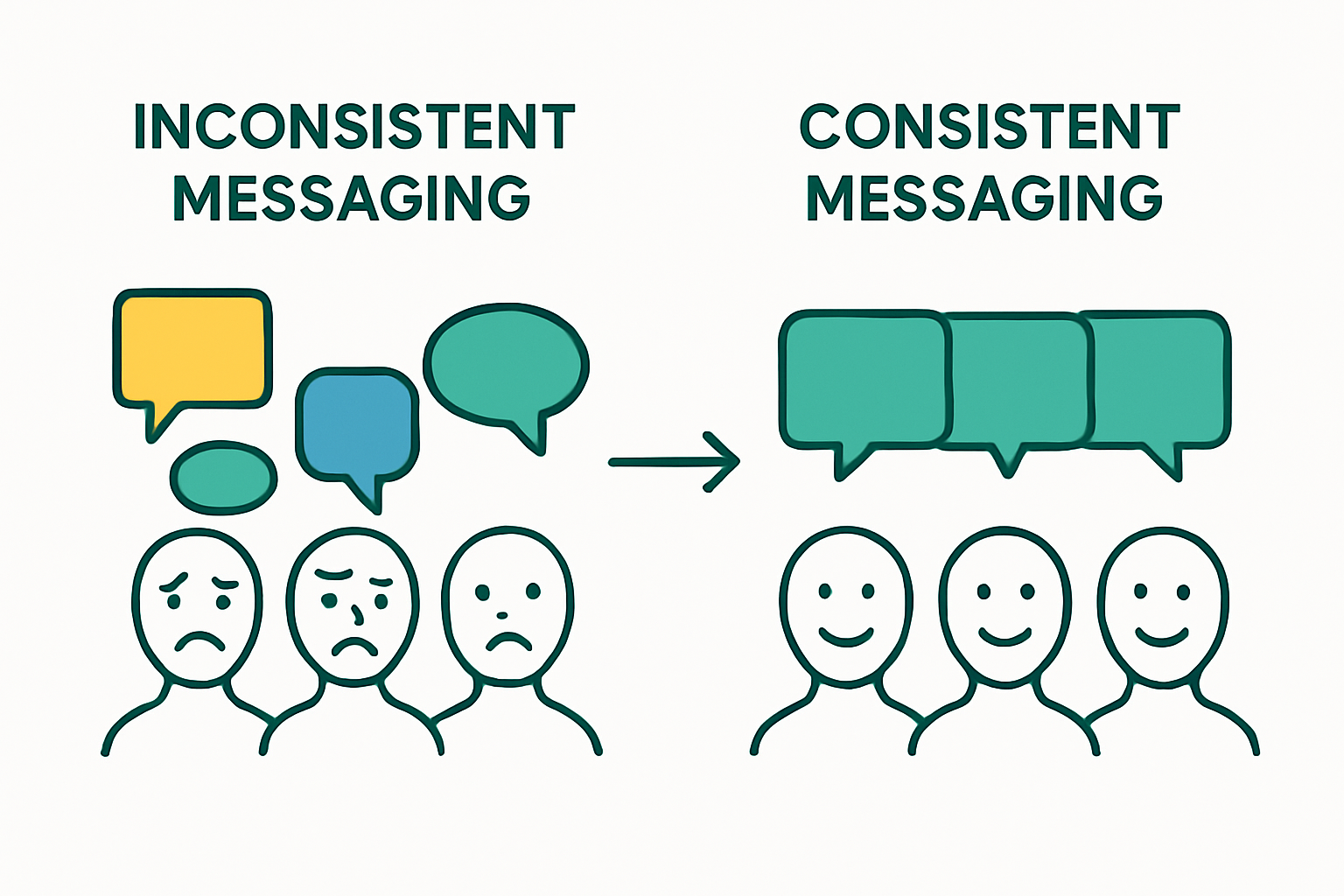
Learn more about crafting a consistent brand strategy to transform how potential customers perceive your business. By methodically addressing messaging variations, you transform scattered communication into a powerful, unified brand narrative that resonates with your target audience and builds long term trust.
Verification checklist for consistent brand messaging:
- Tone matches across all platforms
- Visual elements share common design language
- Core value statements are uniform
- Communication style remains recognizable
- Customer interactions reflect brand personality
Step 2: Define Your Target Audience Clearly
Understanding your target audience is the cornerstone of effective branding that connects authentically with potential customers. Many small businesses make the critical mistake of trying to appeal to everyone, which ultimately means resonating with no one. Your branding strategy must be laser focused on the specific group of people most likely to need and value your products or services.
Start by developing comprehensive customer personas that go beyond basic demographics. These personas should capture not just age and income, but deeper psychological insights like motivations, challenges, aspirations, and communication preferences. Consider creating 2-3 detailed personas representing your ideal customers, exploring their professional backgrounds, personal interests, pain points, and decision making processes.
Research becomes your most powerful tool in this process. Utilize surveys, customer interviews, social media analytics, and market research to gather nuanced information about your potential customers. Explore advanced audience targeting techniques to refine your understanding and develop more precise marketing strategies. Pay attention to the language your potential customers use, the platforms they frequent, and the type of content that genuinely engages them.
Your goal is to develop such a clear picture of your target audience that you can anticipate their needs before they articulate them. Understand not just who they are, but what drives their decisions, what keeps them up at night, and how your product or service can provide meaningful solutions. This depth of understanding transforms your branding from generic communication to a powerful, personalized conversation.
Verification checklist for target audience definition:
- Developed 2-3 detailed customer personas
- Conducted comprehensive audience research
- Identified specific customer pain points
- Mapped communication preferences
- Understand audience’s decision making process
Step 3: Analyze Competitor Branding Strategies
Competitor analysis is not about copying others but understanding the landscape in which your brand operates. Successful branding requires strategic differentiation, not imitation. By carefully examining how other businesses in your market position themselves, you can identify opportunities to stand out and create a unique brand identity that truly resonates with your target audience.
Begin your competitive analysis by creating a comprehensive list of direct and indirect competitors. Direct competitors offer similar products or services, while indirect competitors might solve the same customer problem through different approaches. Use online tools like Google search, social media platforms, industry directories, and professional networks to compile a thorough list. Discover advanced competitive research techniques to uncover insights that can transform your branding strategy.
Dive deep into their branding elements by examining their visual identity, messaging, communication tone, customer interaction style, and overall market positioning. Analyze their website, social media profiles, marketing materials, and customer reviews.
Look beyond surface level aesthetics and focus on understanding the emotional connection they attempt to create with their audience. Pay special attention to the gaps in their branding that you could potentially fill.
Document your findings systematically, creating a comparative analysis that highlights each competitor’s strengths and weaknesses. This exercise is not about feeling intimidated but about identifying strategic opportunities. Your goal is to understand how you can craft a brand message and visual identity that is distinctly different and more compelling than what currently exists in the market.
Verification checklist for competitor branding analysis:
- Identified minimum 5-7 direct and indirect competitors
- Documented visual branding elements
- Analyzed communication and messaging strategies
- Identified potential market positioning gaps
- Created comprehensive competitive research report
Step 4: Develop a Cohesive Brand Identity
A cohesive brand identity is the visual and emotional fingerprint that distinguishes your business in a crowded marketplace. Your brand identity is more than just a logo or color scheme it is the comprehensive representation of your business’s personality, values, and promise to customers. Creating a unified brand identity requires intentional design and strategic thinking that goes far beyond surface level aesthetics.
Begin by establishing a comprehensive brand style guide that serves as your north star for all communication and visual representation. This document should meticulously outline your brand’s color palette, typography, imagery style, tone of voice, and core messaging framework. Explore our comprehensive guide to building a strong brand foundation to ensure you capture every nuanced element of your brand’s unique identity.
Consider how your brand identity will translate across different platforms and mediums. Your visual elements and messaging must remain consistent whether displayed on a business card, website, social media profile, or marketing materials. This means selecting design elements that are versatile yet distinctive. Choose colors that evoke the right emotional response, typography that reflects your brand’s personality, and imagery that authentically represents your business’s core values.
The most powerful brand identities tell a story that resonates emotionally with their target audience. Your brand should communicate not just what you do, but why you do it. Develop a narrative that connects your business’s mission with the specific needs and aspirations of your target customers. This storytelling approach transforms your brand from a mere business offering into a meaningful relationship that customers want to engage with.
Verification checklist for cohesive brand identity:
- Completed comprehensive brand style guide
- Defined consistent visual elements
- Established clear brand messaging framework
- Developed brand storytelling approach
- Verified cross platform design consistency
Step 5: Test Branding Elements with Focus Groups
Focus groups transform your branding strategy from assumption to validated insight, providing critical external perspectives that can dramatically improve your brand’s effectiveness. This step is about gathering honest, unfiltered feedback from potential customers who will give you raw, authentic reactions to your brand’s visual and messaging elements.
Recruiting the right participants is crucial for meaningful results. Aim to select 6-10 individuals who closely match your target audience personas. These participants should represent diverse perspectives within your core customer demographic while maintaining enough commonality to provide coherent feedback. Explore strategic approaches to customer research to ensure you gather the most valuable insights.
Design your focus group session with precision and intentionality. Prepare a structured yet flexible discussion guide that allows participants to explore your branding elements organically. Present your logo, color palette, messaging samples, and marketing materials in a neutral environment. Encourage participants to share not just what they like or dislike, but why they feel a certain way about your brand’s visual and communicative elements. Ask open ended questions that reveal emotional responses and underlying perceptions.
During the session, observe both verbal and non verbal reactions. Pay attention to body language, tone of voice, and spontaneous comments that reveal deeper insights beyond scripted responses. Take detailed notes on participants’ reactions, looking for patterns and consistent themes that emerge across different individuals. These nuanced observations can highlight potential strengths or weaknesses in your brand identity that you might have overlooked.

Verification checklist for focus group testing:
- Recruited 6-10 participants matching target audience
- Developed comprehensive discussion guide
- Documented verbal and non verbal participant reactions
- Identified consistent themes and insights
- Prepared detailed analysis report
Step 6: Monitor Brand Perception and Adjust
Brand perception is a living, breathing entity that requires constant attention and strategic refinement. Monitoring how customers perceive your brand is not a one time task but an ongoing process of listening, understanding, and adapting. Your brand’s reputation can shift quickly in the digital age, making proactive monitoring essential for maintaining a positive market position.
Establish a comprehensive monitoring system that tracks your brand across multiple channels. Utilize digital tools like Google Alerts, social media listening platforms, and review site trackers to capture real time mentions and feedback. Learn more about effective brand monitoring strategies to create a robust tracking mechanism that provides actionable insights into your brand’s public perception.
Develop a systematic approach to analyzing the feedback you receive. Not all comments or reviews require an immediate response, but each provides valuable information about how your brand is perceived. Look for patterns in customer feedback that might indicate broader issues with your messaging, product quality, or customer service. Pay special attention to recurring themes that could signal a need for strategic brand adjustment. This might involve refining your visual identity, updating your communication strategy, or addressing specific customer pain points that emerge from the feedback.
Create a responsive feedback loop that demonstrates your commitment to customer experience. When you receive constructive criticism, view it as an opportunity for growth rather than a threat. Develop a protocol for addressing negative feedback professionally and transparently. Show your audience that you are actively listening and willing to make meaningful changes based on their input.
The table below summarizes the verification checklists from each branding step, helping you quickly ensure all requirements are met for effective brand building.
| Branding Step | Key Checklist Items |
|---|---|
| Identify Inconsistent Brand Messaging | Tone matches, Visual consistency, Core values, Style remains recognizable, Customer interactions reflect brand personality |
| Define Your Target Audience Clearly | 2-3 personas developed, Audience research conducted, Pain points identified, Communication preferences mapped, Understand decision process |
| Analyze Competitor Branding Strategies | 5-7 competitors identified, Visual elements documented, Messaging analyzed, Positioning gaps identified, Competitive report created |
| Develop a Cohesive Brand Identity | Brand style guide completed, Visual elements defined, Messaging framework established, Storytelling approach developed, Cross-platform consistency verified |
| Test Branding Elements with Focus Groups | 6-10 participants recruited, Discussion guide created, Reactions documented, Themes and insights identified, Analysis report prepared |
| Monitor Brand Perception and Adjust | Monitoring tools implemented, Feedback analysis process, Response protocol created, Recurring themes documented, Adjustment strategy developed |
| This approach not only helps improve your brand but also builds trust and demonstrates your business’s dedication to continuous improvement. |
Verification checklist for brand perception monitoring:
- Implemented multiple brand monitoring tools
- Established feedback analysis process
- Created response protocol for customer comments
- Documented recurring brand perception themes
- Developed adjustment strategy based on insights
Turn Branding Mistakes Into Growth With Proven Digital Solutions
Is your small business struggling with inconsistent messaging, unclear branding, or missed connections with your target audience? If you recognize these pain points from our article on costly branding mistakes, you already know how quickly business growth can stall when your branding and marketing are scattered. From identifying inconsistent brand messaging to refining your visual identity and testing your brand’s impact, each step is critical to earning trust and maximizing ROI.
Now is the perfect time to upgrade your branding and online presence with help from experts who deliver measurable results. With Finepoint Design, you get more than just advice. You gain a partner focused on driving ROI through stronger website development, better search engine rankings, and performance-driven online marketing. See how our tailored website development and branding strategies can help you avoid the mistakes holding your business back by connecting with us today. Visit Finepoint Design’s solutions to claim your competitive edge and transform your brand into a growth engine. Ready to stand out and win loyal customers? Let us help you get there—reach out now and start building your success story.
Frequently Asked Questions
What are the common branding mistakes small businesses make?
Small businesses often make mistakes such as inconsistent brand messaging, failing to define their target audience, neglecting competitor analysis, and lacking a cohesive brand identity. These errors can hinder growth and customer engagement.
How can I ensure consistent brand messaging across different platforms?
To ensure consistency, conduct a comprehensive audit of all communication channels. Create a brand messaging guide that outlines your core values, unique selling propositions, and preferred communication style to guide all your messaging.
Why is it important to define a target audience for my brand?
Defining your target audience helps tailor your branding and marketing efforts to meet the specific needs of those who are most likely to value your products or services. This focus leads to more effective messaging and stronger customer connections.
What is the best way to test my branding elements?
Using focus groups is the best way to test your branding elements. Gather a group of individuals who match your target audience and obtain honest feedback about your logo, messaging, and overall brand perception. This feedback can inform necessary adjustments.