How to Boost Ecommerce Sales: Proven Strategies for 2026

Your online sales are growing, but the real story is in the numbers beneath the surface. Most e-commerce stores miss out on high-impact wins because they overlook key data and simple fixes. Over 60 percent of e-commerce traffic now comes from mobile devices, yet many brands still struggle with mobile site speed and intuitive design. This means your biggest revenue boost might come from changes you never expected.
Table of Contents
- Step 1: Analyze Your Current Sales Data
- Step 2: Optimize Your Website For User Experience
- Step 3: Implement Targeted Marketing Strategies
- Step 4: Enhance Product Descriptions And Images
- Step 5: Utilize Customer Feedback For Improvement
- Step 6: Monitor Results And Adjust Strategies
Quick Summary
| Key Point | Explanation |
|---|---|
| 1. Understand Key Sales Metrics | Analyze metrics like conversion rates and customer lifetime value to gain actionable insights about your e-commerce performance. |
| 2. Optimize Website Experience | Ensure fast load times and intuitive navigation to reduce abandonment rates and enhance user satisfaction. |
| 3. Implement Targeted Marketing | Use customer data to create personalized marketing strategies that resonate with specific segments, driving higher engagement. |
| 4. Enhance Product Content | Improve product descriptions and imagery to create emotional connections and clearly communicate benefits to potential buyers. |
| 5. Utilize Customer Feedback | Collect and systematically analyze feedback to identify areas for improvement, fostering loyalty and refining your business strategies. |
Step 1: Analyze Your Current Sales Data
Understanding your current sales performance is the critical foundation for boosting e-commerce revenue. Without a clear picture of where your business stands, any strategy you develop will be built on guesswork. Data analysis transforms random marketing attempts into precise, targeted improvements.
Start by gathering comprehensive sales data from all your digital platforms. This means pulling information from your e-commerce platform, payment processors, and analytics tools. Google Analytics and your platform’s native reporting features will be your primary resources. Look beyond simple total sales figures and dig into granular metrics that reveal deeper insights.
Focus on key performance indicators that truly matter. Track conversion rates, average order value, customer acquisition cost, and product performance. According to research from the National University of Singapore, machine learning algorithms can help identify nuanced patterns in sales data that human analysis might miss.
Pay special attention to these critical metrics:
- Conversion rate by product category
- Time spent on product pages
- Abandoned cart percentages
- Customer lifetime value
- Traffic sources and their respective conversion effectiveness
Compare your current performance against historical data to understand growth trajectories. Are certain products consistently outperforming others? Which marketing channels deliver the most valuable customers? These insights will guide your strategic decisions.
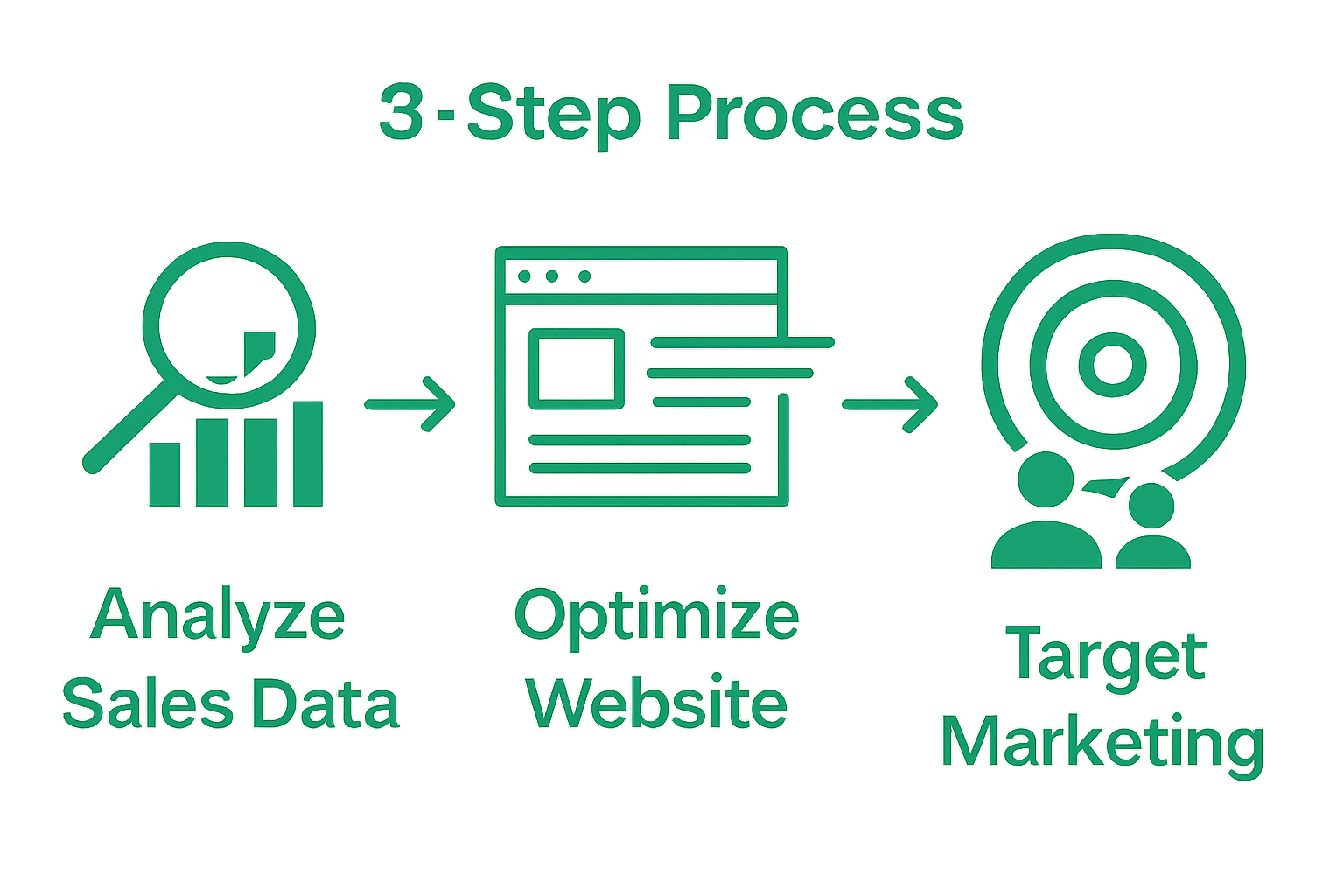
To verify you’ve completed this step effectively, ensure you can answer these questions confidently: What are your top-performing products? Which customer segments generate the most revenue? What are the primary obstacles preventing higher conversions? A thorough analysis transforms raw numbers into a strategic roadmap for e-commerce success.
Step 2: Optimize Your Website for User Experience
User experience transforms casual browsers into committed buyers. Your website must feel intuitive, smooth, and effortless to navigate. Speed and simplicity are your most powerful conversion tools. Potential customers will abandon sites that feel complicated or slow, making website optimization crucial for e-commerce success.
Begin by assessing your current website’s performance using tools like Google PageSpeed Insights. Aim for load times under three seconds across desktop and mobile platforms. Compress images, leverage browser caching, and minimize unnecessary scripts that slow down your site. Learn more about effective web design practices to understand how technical elements impact user engagement.
Design your website with clear, intuitive navigation that guides users seamlessly toward purchasing. Create logical product categories, implement a robust search function, and ensure that each click brings customers closer to completing their purchase. Your checkout process should be streamlined with minimal steps, displaying security indicators to build customer trust.
Mobile responsiveness is no longer optional. According to research from the National University of Singapore, over 60% of e-commerce traffic now originates from mobile devices. Your website must look and function perfectly across smartphones, tablets, and desktops.

Critical elements to verify website optimization include:
- Page load speed under 3 seconds
- Mobile-friendly responsive design
- Clear, intuitive navigation paths
- Simplified checkout process
- High-quality, compressed product images
Test your website from a customer’s perspective. Ask friends or colleagues to navigate your site and provide honest feedback. Watch for hesitations, confusion, or unnecessary clicks. Each moment of friction represents a potential lost sale. Continuous refinement transforms your website from a digital storefront into a smooth, compelling buying experience.
Below is a checklist to help verify your website is fully optimized for user experience, ensuring critical areas are covered before moving to the next strategy.
| Optimization Area | Criteria | Verification Status |
|---|---|---|
| Page Load Speed | Under 3 seconds on all devices | |
| Mobile Responsiveness | Displays and functions perfectly | |
| Navigation | Intuitive and direct product paths | |
| Checkout Process | Minimal steps, secure indicators | |
| Product Images | High-quality, compressed photos |
Step 3: Implement Targeted Marketing Strategies
Targeted marketing transforms generic advertising into precision revenue generation. Your previous data analysis provides the foundation for creating highly personalized marketing approaches that speak directly to specific customer segments. The goal is to deliver the right message to the right customer at the perfect moment.
Segment your audience based on purchasing behaviors, demographics, and historical interaction data. Create distinct customer personas that represent your most valuable buyer types. Each persona requires a unique communication strategy that resonates with their specific needs and preferences. Explore our guide on social media marketing strategies to understand how different platforms can amplify your targeted approach.
Leverage email marketing with hyper-personalized campaigns. Use dynamic content that changes based on individual customer attributes. For instance, a customer who previously purchased running shoes might receive different product recommendations compared to someone who bought casual wear. Automated email sequences can nurture potential buyers through carefully crafted touchpoints.
According to research from the National University of Singapore, AI-driven marketing strategies can significantly enhance customer engagement and conversion rates. Utilize tools like Google Ads, Facebook Business Manager, and specialized marketing platforms that offer advanced targeting capabilities.
Key verification points for successful targeted marketing include:
- Measurable increase in email open rates
- Higher click-through rates on personalized content
- Reduced customer acquisition costs
- Improved conversion rates across marketing channels
- Positive engagement metrics from targeted campaigns
Constantly test and refine your strategies. A/B testing different messaging, visuals, and offers will help you understand what truly motivates your specific customer segments. Marketing is an ongoing conversation with your audience, and the most successful businesses are those that listen and adapt continuously.
Step 4: Enhance Product Descriptions and Images
High-quality product descriptions and images are your silent salespeople, converting casual browsers into committed buyers. Your visual and written content must tell a compelling story that goes beyond basic specifications, creating an emotional connection with potential customers.
Craft product descriptions that solve problems and paint vivid scenarios. Instead of simply listing features, explain how your product improves the customer’s life. Highlight unique benefits, address potential concerns, and use language that speaks directly to your target audience’s aspirations. Learn more about effective copywriting techniques to transform your product narratives.
Photography and visual presentation are crucial. Invest in professional product photography that showcases items from multiple angles, with high-resolution images that allow customers to zoom and examine details. According to research from the National University of Singapore, product images that demonstrate context and usage significantly increase conversion rates.
Utilize lifestyle images that help customers imagine themselves using the product. For clothing, show the item being worn. For tech products, demonstrate the device in a real-world setting. Context transforms a mere product image into an aspirational scene that resonates with potential buyers.
Key elements to verify your product presentation effectiveness include:
- Clear, problem-solving product descriptions
- Professional, high-resolution images
- Multiple product view angles
- Lifestyle and contextual imagery
- Consistent visual branding across all products
Regularly update your product content. Customer preferences and market trends evolve rapidly. What worked six months ago might feel dated today. Continuously refine your descriptions and imagery to maintain a fresh, engaging online presence that speaks directly to your target audience’s current needs and desires.
Step 5: Utilize Customer Feedback for Improvement
Customer feedback is the compass that guides your e-commerce strategy. What customers say about your products, services, and overall experience provides invaluable insights that can transform your business from good to exceptional. Treating feedback as a strategic asset rather than just commentary will unlock profound opportunities for growth and improvement.
Implement multiple channels for collecting customer insights. Encourage reviews directly on your website, leverage third-party review platforms, and create short post-purchase surveys that capture detailed experiences. Learn more about building social proof to understand how customer opinions can influence potential buyers.
Systematically analyze both positive and negative feedback. Look beyond surface-level comments to identify recurring themes, pain points, and potential product or service improvements. Negative reviews are particularly valuable, offering unfiltered insights into areas where your e-commerce experience might be falling short. Develop a structured approach to categorizing and responding to different types of feedback.
According to research from the National University of Singapore, businesses that actively engage with and respond to customer feedback demonstrate higher customer loyalty and increased trust. Publicly acknowledging feedback shows your commitment to continuous improvement and customer satisfaction.
Key verification points for effective feedback utilization include:
- Consistent tracking of customer sentiment
- Measurable improvements based on feedback
- Increased review volume and positive ratings
- Reduced customer complaints over time
- Active response rate to customer comments
Transform feedback into actionable strategies. When customers consistently mention a specific product issue, create an improvement plan. If shipping times are frequently criticized, negotiate with logistics partners or explore alternative shipping methods. Remember, every piece of feedback is an opportunity to refine your e-commerce experience and build stronger customer relationships.
Step 6: Monitor Results and Adjust Strategies
Data transforms guesswork into precision marketing. Monitoring your e-commerce performance isn’t just about collecting numbers – it’s about understanding the story behind those metrics and making intelligent, strategic adjustments. Your ability to read, interpret, and respond to performance data will define your business’s growth trajectory.
Establish a comprehensive dashboard that tracks critical key performance indicators (KPIs). Google Analytics, Shopify Analytics, and specialized e-commerce monitoring tools provide deep insights into customer behavior, conversion rates, and revenue streams. Learn more about creating effective marketing strategies to understand how data-driven decisions can transform your business approach.
Conduct regular performance reviews, ideally monthly or quarterly. Look beyond surface-level metrics and dig into nuanced data points. What are your top-performing products? Which marketing channels deliver the most cost-effective customer acquisition? Where are customers dropping off in the purchasing funnel? Understanding these details allows you to make precise, targeted improvements.
According to research from the National University of Singapore, businesses that implement adaptive performance monitoring strategies can improve their operational efficiency by up to 40%. This means continuously testing, learning, and refining your approach based on real-world data.
Critical monitoring elements to track include:
- Conversion rate trends
- Customer acquisition cost
- Average order value
- Website traffic sources
- Customer retention rates
Remember that successful e-commerce is an ongoing experiment. No strategy is permanently perfect. What works today might become less effective tomorrow. Stay curious, remain flexible, and view each data point as an opportunity to learn and improve. Your willingness to adapt quickly will be your most significant competitive advantage in the dynamic world of online sales.
Here is a quick reference table of critical metrics you should monitor regularly to inform your ongoing e-commerce strategy and optimize for sales growth.
| Key Metric | What It Measures | Frequency |
|---|---|---|
| Conversion Rate | Percentage of visitors that make a purchase | Weekly/Monthly |
| Customer Acquisition Cost | Average cost to acquire a paying customer | Monthly |
| Average Order Value | Average amount spent per transaction | Weekly/Monthly |
| Website Traffic Sources | Where your site visitors are coming from | Weekly/Monthly |
| Customer Retention Rate | Percentage of repeat customers | Monthly/Quarterly |
Ready to Turn Strategies Into Real Ecommerce Sales Growth?
If you are analyzing data, optimizing your website, and launching targeted marketing campaigns but still find your ROI lagging behind, you are not alone. Many businesses struggle to move from behind-the-scenes improvements to concrete revenue gains. It is easy to feel stuck when your conversion rates or average order values do not match your ambition. The article highlights the importance of personalized marketing, seamless user experiences, and actionable performance tracking. But true transformation happens when every component works together for actual results.

Claim your path forward now. Finepoint Design specializes in helping businesses like yours bridge the gap from strategy to success. With solutions in website development and online marketing, we turn proven e-commerce tactics into measurable revenue through better design, SEO, and paid advertising. Discover how you can boost conversions and maximize ROI right away by visiting Finepoint Design. Start building a more profitable online store today while your competitors are still planning.
Frequently Asked Questions
How can I analyze my current e-commerce sales data effectively?
To analyze your e-commerce sales data, gather comprehensive data from your digital platforms, including your e-commerce platform, payment processors, and analytics tools like Google Analytics. Focus on key performance indicators such as conversion rates, average order value, customer acquisition costs, and product performance to gain deeper insights into your business.
What are some effective strategies to optimize my website for user experience?
To optimize your website for user experience, ensure fast loading times (ideally under 3 seconds), implement clear navigation paths, and create a streamlined checkout process. Additionally, utilize mobile-responsive design and high-quality images to enhance user engagement and encourage conversions.
How do I implement targeted marketing strategies for my e-commerce store?
Implement targeted marketing strategies by segmenting your audience based on demographics and purchasing behaviors. Create customer personas and utilize personalized email marketing campaigns. Leverage tools like Google Ads and Facebook Business Manager for advanced targeting capabilities that resonate with specific customer segments.
Why is customer feedback important for improving e-commerce sales?
Customer feedback is crucial as it provides insights into your product and service performance. By actively collecting and analyzing feedback, you can identify recurring issues and opportunities for improvement, ultimately enhancing customer satisfaction, loyalty, and e-commerce sales.