How Search Engines Work for Small Business Owners 2025

Search engines decide which businesses show up and which stay invisible every time someone searches online. Here is the shocker. Over 50 percent of web traffic now comes from mobile devices, and Google favors mobile-friendly sites in rankings. Most small business owners think SEO is too technical or expensive to touch. The truth is, basic search engine tactics are simpler and quicker to apply than you might think—and they can level the playing field for your business in 2025.
Table of Contents
- Understanding The Basics Of Search Engines
- How Search Engines Find And Rank Websites
- Simple SEO Steps For Local Service Businesses
- Common Search Engine Myths For Small Business
Quick Summary
| Takeaway | Explanation |
|---|---|
| Understand Search Engine Operations | Familiarize yourself with the three stages of search engines: crawling, indexing, and ranking, to enhance your digital marketing strategy. |
| Optimize Your Local Online Presence | Claim and fully optimize your Google Business Profile and maintain consistent NAP (Name, Address, Phone number) details across online platforms to improve local search visibility. |
| Address SEO Myths | Recognize that SEO is accessible for small businesses; it doesn’t require extensive resources, and realistic timelines for seeing results range from 4-6 months with continuous updates needed. |
| Prioritize Mobile Optimization | Ensure your website is mobile-friendly, as over 50% of web traffic comes from mobile devices, and Google favors mobile-friendly sites in search rankings. |
| Focus on Quality Content | Create valuable, community-relevant content with localized keywords, as this approach directly addresses user needs and helps improve search engine ranking. |
Understanding the Basics of Search Engines
Search engines are sophisticated digital systems that transform how small business owners connect with potential customers online. At their core, these technological platforms act as digital librarians, sorting through millions of web pages to deliver the most relevant information to users.
The Three Key Stages of Search Engine Operation
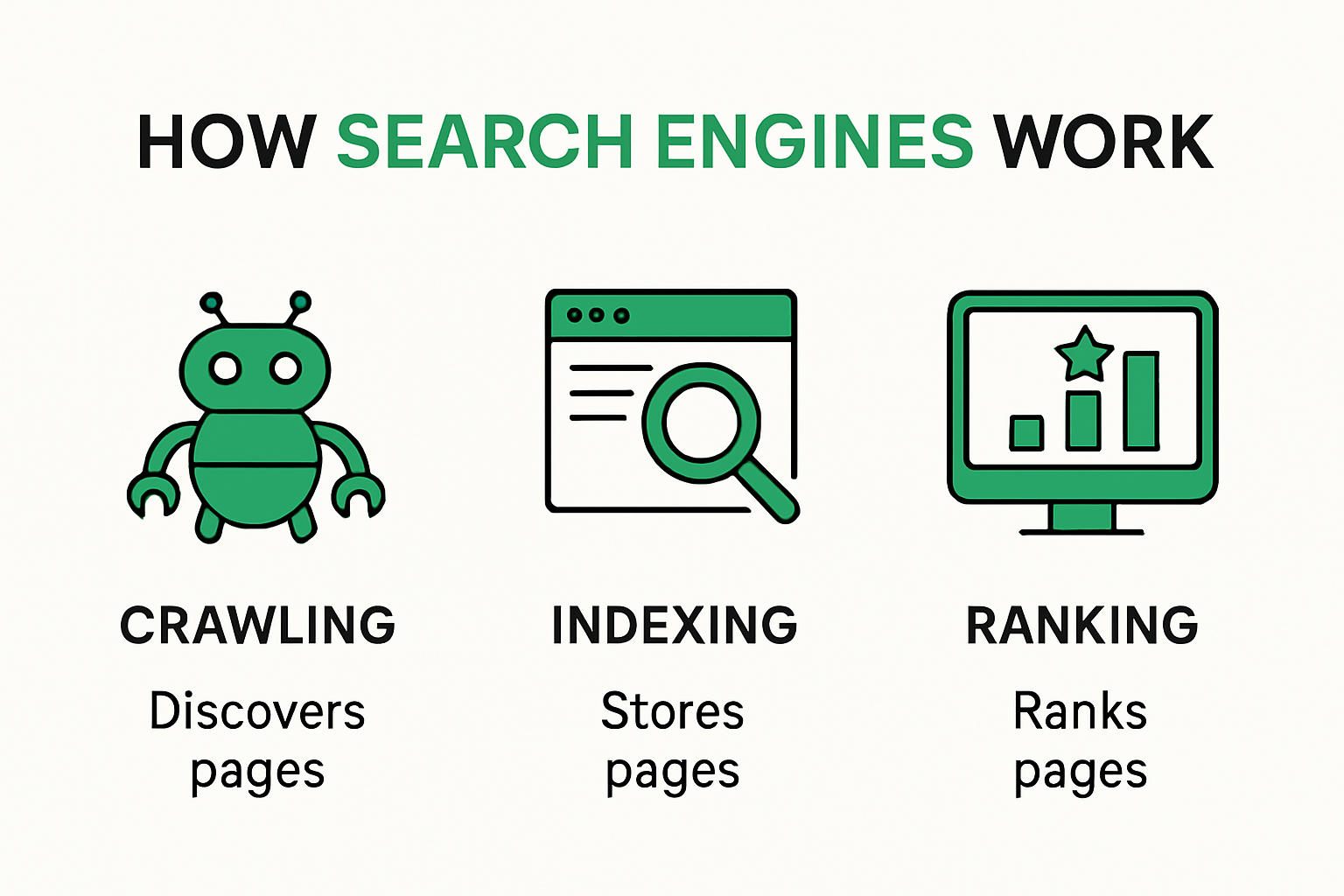
Search engines operate through a precise three-stage process that enables rapid and accurate information retrieval. According to Digital Marketing Institute, these stages include crawling, indexing, and ranking.
Crawling: The Web Discovery Process
Crawlers function like digital explorers, systematically browsing the internet to discover and capture available content. These automated programs navigate through websites by following links, creating a comprehensive map of online information. Each webpage encountered is analyzed and processed, with its content and metadata recorded for future reference.
Indexing: Organizing Digital Information
After crawling, search engines enter the indexing phase. Here, collected web content is meticulously analyzed and organized into massive databases. As Scientific American explains, this process involves parsing web pages to extract key words and store them alongside corresponding page links. This sophisticated indexing allows for incredibly fast retrieval of information when users submit search queries.
The Role of Search Algorithms in Ranking
Search algorithms represent the brain behind search engine functionality. These complex mathematical formulas determine which web pages appear in search results and in what order. According to How Stuff Works, ranking algorithms consider multiple factors including:
- Keyword Relevance: How well a webpage matches search terms
- Content Quality: The depth and usefulness of information
- Page Authority: The credibility and reputation of the website
- User Engagement: How users interact with the webpage
For small business owners, understanding these algorithmic principles is crucial. Your website’s visibility depends on how well it aligns with these ranking criteria. Optimizing your online content to meet these standards can significantly improve your chances of appearing in top search results.
Modern search engines continuously refine their algorithms, making the digital landscape dynamic and competitive. This means small business owners must stay informed and adaptable, consistently updating their online strategies to maintain strong search engine performance.
The key takeaway is simple: Search engines are not just technological tools but sophisticated platforms that connect businesses with potential customers. By comprehending their fundamental operations, small business owners can develop more effective digital marketing strategies that enhance online visibility and drive growth.
Here’s a table summarizing the three key stages of search engine operation for quick reference.
| Stage | Purpose | Key Activities |
|---|---|---|
| Crawling | Discover new and updated content | Web crawlers browse/follow links |
| Indexing | Organize and store discovered content | Content and keywords analyzed, stored |
| Ranking | Determine search result order | Algorithms assess and rank content |
How Search Engines Find and Rank Websites
Search engines employ complex mechanisms to discover, evaluate, and rank websites, creating a sophisticated digital ecosystem that determines online visibility for small businesses. Understanding these intricate processes can help business owners strategically optimize their web presence.
Web Discovery and Indexing Techniques
Search engines utilize advanced crawling technologies to systematically explore the internet. According to research from Springer, modern search engines now incorporate machine learning algorithms like RankBrain to interpret search queries more intelligently, moving beyond simple keyword matching.
Web crawlers navigate through websites by following hyperlinks, creating a comprehensive map of online content. These digital explorers analyze web pages, capturing metadata, content structure, and contextual information. The collected data is then processed and stored in massive indexed databases, enabling rapid retrieval during user searches.
Ranking Algorithms and Evaluation Criteria
Ranking websites involves complex mathematical models that assess multiple factors. Arxiv Research highlights the PageRank algorithm as a critical component, which evaluates web page importance by analyzing the quantity and quality of links pointing to a site.
Key ranking factors include:
- Content Relevance: How closely webpage content matches user search intent
- Backlink Quality: Number and authority of external websites linking to the page
- User Experience Signals: Metrics like page load speed, mobile responsiveness
- Website Security: Presence of SSL certificates and secure browsing protocols
According to MDPI Research, search engines now consider sophisticated user behavior metrics such as:
- Bounce rate
- Time spent on page
- Click-through rates
- User engagement patterns

Machine Learning and Continuous Adaptation
Modern search engines are not static systems but dynamic platforms continuously learning and evolving. Machine learning algorithms enable search engines to understand nuanced user intentions, delivering increasingly personalized and accurate search results.
For small business owners, this means consistently updating website content, maintaining technical excellence, and focusing on genuine user value. Search engines reward websites that provide clear, authoritative, and engaging information that directly addresses user needs.
The digital landscape is competitive, and search engine algorithms change frequently. Staying informed about these technological shifts and adapting your online strategy accordingly is crucial for maintaining and improving your website’s search visibility.
Successful online visibility requires a holistic approach. It’s not just about implementing technical optimizations but creating a comprehensive digital experience that genuinely serves your target audience’s needs and expectations.
Simple SEO Steps for Local Service Businesses
Local service businesses have unique opportunities to leverage search engine optimization strategies that can dramatically improve their online visibility and attract more customers. By implementing targeted SEO techniques, small business owners can compete effectively in their local markets.
Optimizing Your Local Online Presence
The foundation of local SEO begins with establishing a robust online identity. According to Business Development Canada, claiming and fully optimizing your Google Business Profile is crucial for local search success.
Key Steps for Local Profile Optimization:
- Complete every section of your Google Business Profile
- Add high-quality, professional images of your business
- Ensure accurate business hours and contact information
- Select precise business categories that match your services
Consistent business information across online platforms is critical. Yoast SEO emphasizes the importance of maintaining uniform Name, Address, and Phone number (NAP) details across all digital directories. This consistency helps search engines validate your business’s legitimacy and improves local search rankings.
The following table presents a checklist to help local businesses optimize their Google Business Profile presence step-by-step.
| Optimization Step | Completed? |
|---|---|
| Complete all sections of Google Business Profile | |
| Add high-quality business images | |
| Ensure accurate business hours and contact info | |
| Select precise business categories | |
| Maintain consistent NAP details across directories |
Building Local Credibility and Trust
Customer reviews play a pivotal role in local SEO strategies. HubSpot Research reveals that customer reviews not only build trust with potential clients but also significantly influence local search rankings.
Effective review management strategies include:
- Actively encouraging satisfied customers to leave reviews
- Responding professionally to all reviews, both positive and negative
- Creating easy pathways for customers to share their experiences
- Monitoring and managing your online reputation across multiple platforms
Content and Keyword Strategies for Local Businesses
Local service businesses must develop content that speaks directly to their community. This means creating website content, blog posts, and social media updates that incorporate local keywords and address specific community needs.
Strategic keyword approaches include:
- Using location-specific keywords (e.g., “plumber in [city name]”)
- Creating content about local events, community involvement
- Highlighting local customer success stories
- Developing location-specific service pages
Technical website elements also matter. Ensure your website is mobile-friendly, loads quickly, and includes structured data markup that helps search engines understand your business context.
Remember, local SEO is an ongoing process. Search engine algorithms continually evolve, so small business owners must remain adaptable. Regularly updating your online profiles, creating valuable local content, and maintaining a strong online reputation are key to sustained digital success.
By implementing these strategic SEO steps, local service businesses can enhance their online visibility, attract more targeted customers, and compete effectively in their local markets. The goal is not just to be found online, but to be the most attractive and trustworthy option for potential customers searching for your services.
Common Search Engine Myths for Small Business
Search engine optimization can feel like a complex maze for small business owners, often leading to misconceptions that can hinder digital marketing efforts. Understanding and dispelling these myths is crucial for developing an effective online strategy.
Misconceptions About SEO Complexity
Many small business owners believe SEO is an insurmountable technical challenge reserved for large corporations with extensive resources. According to Great Lakes Digital Partners, this is a fundamental misunderstanding. SEO is accessible and can be implemented strategically, even with limited budgets and technical expertise.
Common Myths About SEO Difficulty:
- SEO requires advanced technical skills
- Only large businesses can achieve good search rankings
- Professional help is always necessary
- SEO is too expensive for small businesses
In reality, many SEO strategies can be implemented incrementally and cost-effectively. Small business owners can start with basic optimizations and gradually enhance their approach as they learn and grow.
The Truth About SEO Timelines and Expectations
Marketing Type Guys highlight a critical myth: expecting immediate results from SEO efforts. Search engine optimization is a long-term strategy that requires consistent effort and patience.
Key insights about SEO timelines:
- Realistic Expectation: SEO results typically take 4-6 months to become noticeable
- Continuous Process: Regular content updates and strategic improvements are essential
- Incremental Progress: Small, consistent improvements compound over time
Mobile Optimization and Search Performance
Another prevalent myth suggests mobile optimization is optional. However, with mobile internet traffic now dominating digital interactions, this misconception can severely impact a business’s online visibility.
Critical mobile optimization facts:
- Mobile devices account for over 50% of web traffic
- Google prioritizes mobile-friendly websites in search rankings
- Poor mobile experiences directly reduce search performance
- Responsive design is no longer a luxury but a necessity
Small business owners must recognize that search engines continuously evolve their algorithms. What worked yesterday might not be effective tomorrow. Staying informed, adaptable, and committed to providing genuine value to online visitors is the most reliable SEO strategy.
Understanding these myths helps small business owners approach search engine optimization more confidently. It’s not about implementing complex techniques but about consistently delivering quality content, maintaining a user-friendly website, and genuinely addressing customer needs.
The most successful approach combines basic technical optimization, quality content creation, and a commitment to understanding your target audience’s online behaviors. SEO is less about gaming the system and more about creating an excellent online experience that search engines naturally want to promote.
Frequently Asked Questions
What are the basic functions of search engines?
Search engines perform three primary functions: crawling, indexing, and ranking. They discover web content, organize it in databases, and determine the order in which results appear in response to user queries.
How can small businesses improve their search engine rankings?
Small businesses can improve their search engine rankings by optimizing their website for mobile-friendliness, claiming and fully optimizing their Google Business Profile, and creating high-quality, relevant content that includes localized keywords.
How long does it typically take to see results from SEO efforts?
SEO results usually take 4-6 months to become noticeable. It’s important for small business owners to be patient and consistently update their content and strategies during this time.
Why is mobile optimization important for search engines?
Mobile optimization is crucial because over 50% of web traffic comes from mobile devices. Google prioritizes mobile-friendly sites in search rankings, affecting visibility and user experience.
Ready for Your Small Business to Rank Where It Matters?
You just learned how search engines use crawling, indexing, and ranking to decide if your business is seen online or left behind. For most small business owners, the real struggle is standing out in crowded search results. The article made it clear that local visibility, mobile optimization, and clear profiles mean everything. Do you worry your website is not being found by customers in your area? Are you missing out on calls, sales, and requests because you think SEO is too complex or costly?

Stop losing ground to competitors who have figured it out. The Finepoint Design team helps local businesses like yours achieve better search rankings and real ROI through proven website development and targeted online marketing. Let us show you how easy it can be to claim your Google Business Profile, build trust, and get results with strategies shaped around the latest search engine science. Visit our home page now to start your path to more calls, leads, and measurable growth.